Introduction
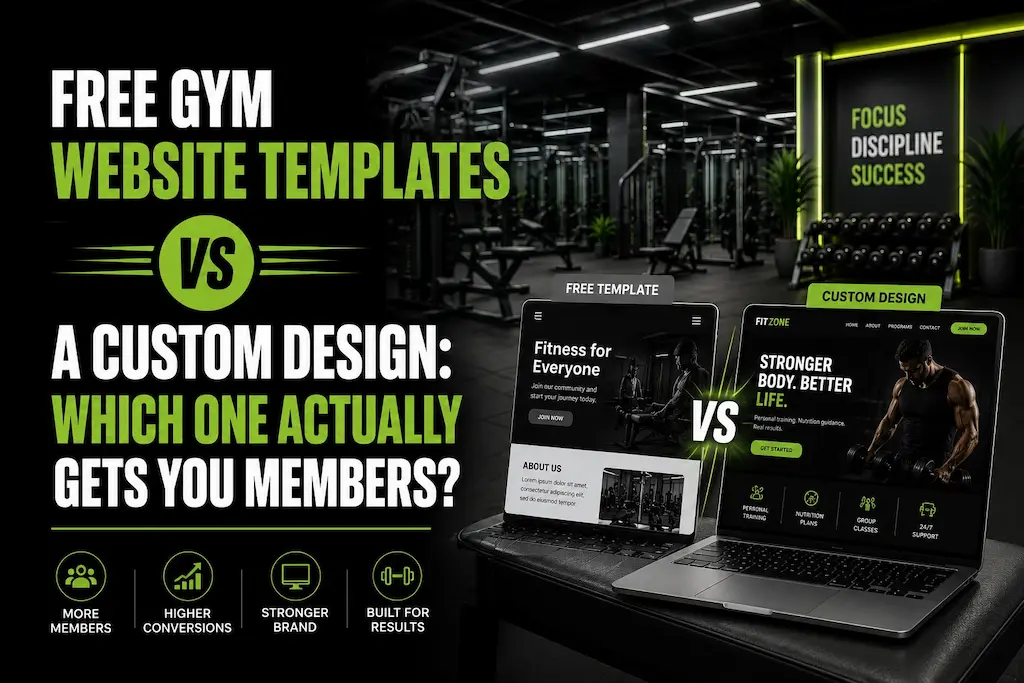
Free Gym Website Templates vs a Custom Design is a common comparison for gym owners, personal trainers, and fitness studios looking to build a professional online presence. While free templates can help you launch quickly with minimal costs, they often lack the customization, SEO features, and conversion tools needed to attract new members. Understanding Free Gym Website Templates vs a Custom Design allows you to make a smarter investment based on your business goals, budget, and long-term growth strategy. Whether you’re opening a new gym or redesigning an existing website, choosing the right solution can directly impact your membership numbers.
At Abdulqadeer.click, we compare Free Gym Website Templates vs a Custom Design to help fitness businesses create high-performing, SEO-friendly websites that generate more leads, increase memberships, and deliver real business results.
This post breaks down the real difference between free gym website templates and a custom built site. No fluff, no sales pitch dressed up as advice. Just what works, what does not, and how to decide which route suits your gym.
What Are Free Gym Website Templates?
A free gym website template is a ready made design you can download or plug into a website builder. Someone else has already decided the layout, the colours, the fonts and the structure. You add your gym’s name, some photos, a bit of text, and you are live.
You will find these on platforms like WordPress, Wix, Squarespace and Canva. Search “gym website design templates free download” and you will get pages of results. Some are genuinely well made. Others are outdated, slow, or built for a completely different type of business and lightly rebranded for fitness.
The appeal is obvious. No design skills needed. No developer fees. No waiting weeks for a build. You can have something online in an afternoon.
The Real Appeal of a Free Gym Website Template
Let us be fair to free templates before we pick them apart. There are good reasons gym owners choose this route, especially in the early days.
Speed. You can launch fast. If your gym has no website at all right now, a free template is better than nothing.
Cost. Zero pounds upfront. For a new gym watching every penny, that matters.
Simplicity. Most builders offer drag and drop editing. You do not need to know code.
Testing the water. If you are unsure whether you even need a strong online presence yet, a free site lets you test that without commitment.
For a very small studio, a one person personal training business, or someone just starting out, this can be a reasonable short term fix. The problem is that most gyms outgrow this stage fast, and many never realise the template is holding them back.
Where the Free Route Starts to Show Cracks
Here is where things get honest. Free templates are not built for your gym. They are built to be generic enough to suit thousands of businesses at once. That is the whole point of them being free and reusable.
This creates a few problems.
Every competitor looks the same. If you search “gym websites uk” you will notice a pattern. Dozens of local gyms using the same three or four template designs, just with different logos. When a potential member compares five gyms in your area and three of them look identical, none of them stand out. You lose the chance to look different, let alone better.
Weak SEO foundations. Free templates are rarely built with search engines in mind. The code is often bloated, page speed suffers, and the structure does not support the kind of on page SEO a gym needs to rank locally. If someone searches “gym near me” or “personal training in [your town]”, a poorly optimised template site will struggle to appear, no matter how nice it looks.
No room for growth. Class timetables, membership sign up forms, payment integration, member login areas. Most free templates cannot handle this without expensive plugins or a rebuild further down the line.
Generic messaging. A template is not written around your gym’s tone, your trainers, your results, or your community. Visitors can sense when a site feels copied and pasted. It quietly damages trust.
Mobile and loading issues. Many free templates are not properly optimised for mobile, even though most people will find your gym on their phone first. A slow, clunky mobile experience sends people straight back to Google to click on the next result instead.
None of this means free templates are useless. It means they come with limits that matter a lot for a business trying to convert visitors into paying members.
What a Custom Gym Website Actually Gives You
A custom built website is designed around your gym specifically. Your branding, your member journey, your local market, your goals. It is not about spending more money for the sake of it. It is about building something that works harder for you.
Here is what changes with a custom approach.
Design that reflects your gym. Your colours, your photography, your story, your unique selling points. If you specialise in strength training, women’s only sessions, or boxing, the site can be built to reflect that from the first scroll.
SEO built in from day one. A properly built site is structured for search engines. Fast loading, clean code, proper headings, local SEO elements, and content built around how people actually search. This is where working with a gym website designer in UK markets specifically makes a real difference, because they understand local search behaviour, UK fitness trends, and what UK members expect from a gym website.
Clear conversion paths. Every button, form and page is designed to move a visitor towards booking a class, starting a trial, or getting in touch. Free templates often bury these actions or make them generic. A custom site puts them exactly where they need to be.
Room to scale. Class bookings, membership management, blog content, video, member testimonials. A custom build can grow with your gym instead of forcing a rebuild every time you add a feature.
Trust signals that convert. Real photos of your space, your trainers, your members. Reviews placed strategically. Local landmarks and area names mentioned naturally. These small details build trust with someone comparing gym websites UK wide before choosing where to sign up.
If you want to see what this looks like in practice, our gym digital marketing services page breaks down exactly how a custom gym website fits into a wider strategy for getting members, not just visitors.
Free Templates vs Custom Design: A Side by Side Look
| Factor | Free Template | Custom Design |
| Upfront cost | Free or very low | Investment required |
| Launch speed | Fast, days | Slower, but built right first time |
| Uniqueness | Low, widely reused | High, built around your gym |
| SEO strength | Weak by default | Strong, built in from the start |
| Mobile performance | Often poor | Optimised for real users |
| Scalability | Limited | Built to grow with you |
| Conversion focus | Generic | Designed around your member journey |
| Long term cost | Rebuild costs add up | One solid investment |
This table sums up the trade off. Free templates win on speed and initial cost. Custom design wins on almost everything that actually brings members in. Read more : 15 Gym & Fitness Website Design Examples to Inspire Your 2026 Rebrand
Why This Matters More for Gym Websites in the UK
The UK fitness market is competitive. Whether you are in a small town or a busy city, there is a good chance three or four other gyms are fighting for the same local searches you are.
When someone searches for gym websites UK based, or searches locally for a gym near them, Google is not just looking at design. It is looking at speed, structure, relevance, and how well the site answers what people are actually searching for. Free templates rarely tick all these boxes well enough to compete.
There is also a UK specific expectation around trust. British consumers tend to research thoroughly before committing to a membership, especially with the rise in gym prices and the popularity of boutique studios. A website that feels generic or copied from a template does not build the confidence needed to get someone to commit.
Working with a gym website designer based in the UK based, who understands the local fitness landscape, means the site is built with UK search habits, UK competitors, and UK member expectations in mind. That local context is something a downloaded template simply cannot offer.
SEO, AEO and GEO: The New Rules for Gym Websites
Search has changed. It is no longer just about ranking on Google. People now ask questions directly to AI tools, voice assistants, and search engines that generate answers instead of just listing links. This is where AEO, answer engine optimisation, and GEO, generative engine optimisation, come into play alongside traditional SEO.
For a gym website, this means content and structure need to answer real questions clearly. Things like “what is the best gym in [town]” or “how much does a personal trainer cost in the UK” need to be answerable directly from your site’s content, not buried in vague marketing copy.
Free templates are not built with this in mind. Their content blocks are often placeholder text lightly edited, not structured around real search intent. A custom site can be built with clear headings, direct answers, local keywords, and content structured the way modern search engines and AI tools actually read pages.
If you want to understand more about how this shift is affecting small businesses, I have written about it in more depth on my Medium page, where I break down practical examples of AEO and GEO for local businesses like gyms and studios.
So Which One Actually Gets You Members?
Here is the honest answer. A free gym website template can get you online. It rarely gets you members at the rate a custom site can.
Members are not just choosing a gym based on price or location anymore. They are comparing websites, reading reviews, checking class timetables, and deciding within seconds whether a gym looks professional and trustworthy. A generic template competing against other generic templates does not win that comparison easily.
A custom website, built around your specific gym, your area, and your ideal member, gives you a real edge. It loads faster, ranks better, and guides visitors towards actually booking a trial or signing up. That difference shows up directly in your numbers.
Take a look at how a well built fitness website structures its content and booking flow. Sites like Gutzfit show what a clean, purpose built fitness site looks like when every section is designed with intent rather than pulled from a generic template. Read More : What Is A Digital Marketing Strategy That Can Bring Results For Your Gym?
How to Choose the Right Path for Your Gym
Not every gym needs a full custom build immediately. Here is a simple way to think about it.
Choose a free template if: You are just starting out, have no existing online presence, and need something live within days while you plan a proper site for later.
Choose a custom design if: You already have members but want more, your current site is not converting visitors, you are losing local search visibility to competitors, or your brand deserves better than a copied layout.
Most established gyms fall into the second category without realising it. They launched with a free template years ago, never revisited it, and are now wondering why enquiries have slowed down while a competitor two streets away seems to be filling classes faster.
If that sounds familiar, it is worth getting a second opinion before committing to another year on a site that is not pulling its weight.
A Quick Word on Cost
Cost is usually the deciding factor, so let us address it directly. A custom gym website is an investment, not an expense you write off. A well built site keeps working for you every single day. It ranks, it converts, and it represents your gym properly around the clock.
Compare that to the hidden cost of a free template. Lost enquiries because the site loads slowly. Lost trust because it looks like every other gym’s site. Lost ranking because the SEO foundation was never there to begin with. These costs are harder to see, but they add up month after month.
Final Thoughts
Free gym website templates have their place. They are fast, cheap, and fine for a temporary solution. But if you are serious about growing your membership, competing with other gym websites UK wide, and showing up when people search locally, a custom design built by someone who understands the fitness industry makes a real difference.
Your website is often the first real interaction someone has with your gym. It should look like it belongs to you, not a template downloaded by a thousand other businesses.
If you want to see what a strong gym website should actually look like, or if your current site has stopped bringing in the inquiries it used to, start by exploring what a proper build could do for you. You can check out the full range of options on the home page, or go straight ahead and book a free audit call to get honest feedback on where your current website stands.
No pressure, no jargon. Just a clear look at what is working, what is not, and what would actually move the needle for your gym.