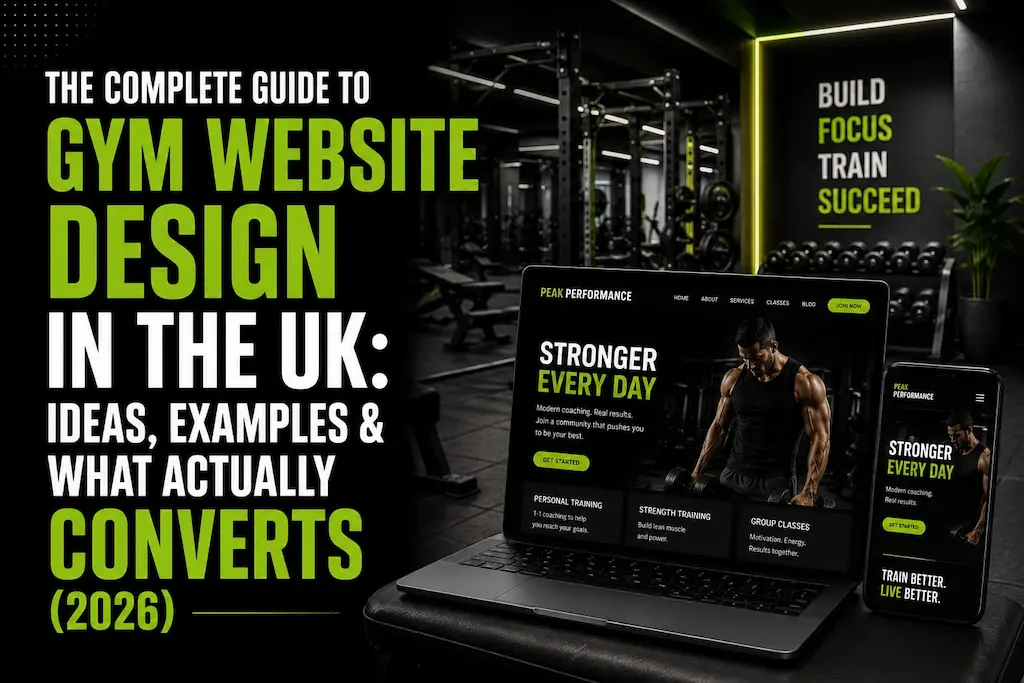
Gym Website Design in the UK plays a crucial role in attracting new members, building trust, and increasing online bookings in today’s competitive fitness industry. Whether you own a local gym, personal training studio, CrossFit box, or fitness coaching business, investing in professional Gym Website Design in the UK can significantly improve your online presence and conversion rates. From responsive layouts and compelling calls-to-action to SEO optimization and seamless membership sign-ups, every detail matters.
If you’re looking for inspiration, practical examples, and proven strategies, this guide covers everything you need to know about Gym Website Design in the UK. Discover the latest design trends, conversion-focused features, and real-world ideas that help fitness businesses grow and turn more website visitors into loyal gym members in 2026.
If you want a professional to build this for you rather than doing it yourself, our gym website design and marketing services cover exactly this. You can also book a free 30 minute audit call if you want a second opinion on your current site before you read any further.
Quick Summary (Key Takeaways)
- A gym website’s job is conversion, not decoration. Every design choice should support a booking, a call, or a free trial sign up.
- Mobile design is not optional. More than half of UK gym website visitors are on a phone.
- Free gym website design templates are a fine starting point but rarely convert as well as a site built around your actual member journey.
- AEO and GEO (Answer Engine Optimisation and Generative Engine Optimisation) now matter as much as traditional SEO, because people ask AI tools for gym recommendations, not just Google.
- Real examples beat generic templates. Look at how UK gyms and coaches such as Gutzfit structure their booking funnel.
What Makes a Gym Website Actually Convert
Before any gym website design ideas, you need to understand what a visitor is actually doing on your site.
Most people land on a gym website already interested. They found you through a Google search, an Instagram bio link, or a friend’s recommendation. They are not browsing for fun. They want three things, fast: proof you are legitimate, clarity on price and location, and an easy way to take the next step.
A converting gym website answers these three questions within seconds:
- What is this place and who is it for?
- What does it cost, and where is it?
- How do I try it or book it right now?
If your homepage makes someone scroll for thirty seconds before finding a phone number or a booking button, you are losing members. This is the single biggest gap between an average gym website and one that fills classes.
Read More : Free Gym Website Templates vs a Custom Design: Which One Actually Gets You Members?
Gym Website Design Ideas That Work in 2026
These are not decoration tips. Each of these gym website design ideas is tied to a specific outcome, more enquiries, more trial bookings, or more trust.
1. A hero section with one clear action
Your homepage banner should have one headline, one short line of support text, and one button. Not three. Visitors get confused when given too many choices, and confused visitors leave.
2. Live, mobile-friendly class timetables
A timetable that only works on desktop, or one that needs a login just to view class times, is a conversion killer. Show the timetable clearly and let people book straight from it.
3. Video over static photos
Short video clips of your gym floor, a class in progress, or a coach explaining a programme build far more trust than stock photography. People want to see the real space before they turn up.
4. Transparent pricing
Hidden pricing forces people to fill in a form just to find out if they can afford you. Some gyms worry that showing prices scares people off. In practice, hiding prices scares off more people than it protects.
5. Social proof placed near the CTA
Reviews and testimonials work best when they sit right next to your booking button, not buried on a separate page. Seeing proof and having the option to act on it in the same glance shortens the decision.
6. A free trial or taster session offer
This is still one of the strongest fitness website design ideas going. A single free class or a seven day trial reduces the risk for a first time visitor and gives your sales team a warm lead to follow up.
7. Local search structure built in
Your site needs pages, headings, and content structured around your actual location. “Gym in [your town]” style content, done properly and not stuffed with keywords, still drives real local traffic.
8. Fast load times on mobile data
A beautiful website that takes six seconds to load on 4G will lose visitors before they see anything. Compress images, cut unnecessary animation, and test on an actual phone, not just a laptop.
9. A simple, human “About” page
People join gyms run by people they trust. A short, honest page about who runs the gym, why it exists, and what makes it different works harder than most owners expect.
10. One obvious way to contact a real person
WhatsApp buttons, click-to-call numbers, and short enquiry forms all outperform long contact forms with ten fields. Every extra field is a reason for someone to give up halfway through.
Fitness Website Design Inspiration: Where to Find It
Good fitness website design inspiration is not about copying a layout. It is about noticing patterns that repeat across websites that clearly work, then applying the parts that fit your gym.
A useful place to browse a wide range of real gym website design inspiration in one spot is 99designs’ gym website gallery, which collects dozens of live examples across different gym types, from boutique studios to large commercial clubs. Scroll through with a specific question in mind: how quickly can I find the booking button on this site? That single question filters out a lot of style-over-substance design.
We also break down specific layout and conversion examples in more depth on our Medium page, if you want more detailed walkthroughs than fit in this guide.
When you are gathering fitness website design inspiration, resist the urge to save every attractive site you find. Save the ones that solve a specific problem you currently have. If your timetable page is confusing, go find three sites with a genuinely clear timetable and study exactly how they laid it out.
Gym Website Design Examples by Business Type
Different types of gyms need different websites. A gym website design example that works brilliantly for a 24 hour commercial gym would fall flat for a small personal training studio, and vice versa.
Boutique fitness studios
Boutique studios, think small group training, Pilates, or spin, tend to convert best with a strong visual identity, a clear class schedule, and an easy first-class offer. The design should feel intimate and premium rather than corporate.
24/7 commercial gyms
Large gyms with round the clock access need to lead with convenience and value. Membership tiers, access hours, and facility photos matter more here than personal storytelling. The site should make joining feel as simple as the gym itself.
CrossFit boxes and functional training gyms
These sites work best when they show real community. Member photos, class intensity, and a straightforward “book your free session” path outperform slick corporate design every time.
Personal trainers and online coaches
This is where the funnel matters most, because there is usually one person doing the selling. A good fitness website design example in this category is Gutzfit, a UK based coaching business. Its site leads with a single clear action, booking a strategy call, and walks visitors through a short, structured process: book a call, attend a short consultation, then get matched to the right coaching package. Client results and testimonials sit close to the booking buttons throughout, and the packages are laid out with clear pricing rather than a vague “get in touch” message. That structure, one goal, a short clear path, proof placed near the action, is worth studying regardless of what kind of fitness business you run.
Community and council leisure centres
These sites often serve many different audiences at once, from swimmers to gym members to class attendees. The best examples use strong navigation and search rather than trying to cram everything onto the homepage.
Gym Website Design Templates: Free Download Options
Searching for gym website design templates free download will bring up plenty of results, mostly from WordPress theme marketplaces, Wix, Squarespace, Elementor, and Webflow. These are worth understanding before you use one.
WordPress themes. Free WordPress gym themes are widely available and give you a working starting point fast. The trade-off is that most gyms using the same free theme end up with near identical websites, which does nothing for how memorable your brand is.
Wix and Squarespace fitness templates. Both platforms offer free fitness themed templates with drag and drop editing. These suit small studios and personal trainers who need something live quickly and do not yet need advanced booking integrations.
Elementor and Webflow kits. These give more design flexibility but usually need more technical confidence to customise properly.
A free template is a reasonable starting point if your budget genuinely will not stretch further right now. But treat it as a placeholder, not a final answer. Templates are built to look good in a demo, not to match your specific member journey, your local search terms, or your booking software. Most gyms that start with a free template end up rebuilding within a year once they realise how much it is limiting their enquiries.
If you would rather skip the trial and error, our team builds gym websites designed around conversion from day one. You can see what that looks like on our gym website and digital marketing services page.
What Actually Converts: The Details Most Gyms Get Wrong
This is the part most guides skip. Design ideas are easy to list. Getting the conversion mechanics right is harder.
Speed beats polish.
A plain website that loads in one second will out-convert a gorgeous website that loads in five. Every additional second of load time on mobile increases the chance someone leaves before your site even finishes rendering.
One CTA per page, repeated, not varied.
Do not offer “Join Now,” “Book a Class,” and “Get a Quote” on the same page. Pick one action per page and repeat that same button several times as people scroll.
Forms should ask for less, not more.
Name, phone number, and preferred time is usually enough for a first enquiry. You can gather more detail once someone is already talking to you.
Trust signals need to be specific.
“Rated 4.9 out of 5” with a real number of reviews works far better than a vague claim like “loved by our members.” Specificity reads as honest.
Urgency should be true, not manufactured.
If your intro offer genuinely ends this month, say so. Fake countdown timers that reset every visit damage trust the moment someone notices, and gym-goers talk to each other.
Local proof matters more than global proof.
A testimonial from someone in the same town carries more weight than a generic five star rating from an unknown source. If you have reviews mentioning your area by name, feature them.
AEO, SEO, and GEO Explained for Gym Websites
Traditional SEO, search engine optimization, is about ranking well on Google. That still matters. But two newer disciplines now shape how people find gyms online, and most UK gym websites are not built for either yet.
AEO, Answer Engine Optimisation, is about getting your content picked up as the direct answer to a question, whether that is a Google featured snippet, a voice search result, or an AI generated summary at the top of a search page. To do this well, structure your content around real questions people ask, “how much does a gym membership cost in [town],” “is there a 24 hour gym near me,” and answer them in short, clear, factual sentences near the top of the relevant page.
GEO, Generative Engine Optimisation, is newer still. It is about how your gym gets mentioned when someone asks an AI tool like ChatGPT, Gemini, or Perplexity for a recommendation, rather than typing into Google at all. These tools favour content that is specific, well structured, and easy to extract facts from. Clear headings, direct answers, and factual detail (address, opening hours, pricing, class types) all help here far more than clever marketing copy.
Practically, this means your gym website design needs to support both humans and machines reading it. Use proper heading structure, write plain answers to common questions, keep your business details consistent across your website and your Google Business Profile, and avoid burying key facts inside images or video where they cannot be read as text.
How to Choose a Gym Website Designer in the UK
Searching for a gym website designer in the UK will turn up everyone from large agencies to solo freelancers to fitness-specific specialists. Here is what actually separates a good hire from a wasted budget.
Ask to see gym-specific work, not just any website. A designer with a strong portfolio of restaurants or law firms will not automatically understand how a class booking funnel needs to work, or why your timetable page matters more than your homepage banner.
Ask how they measure success. A good gym website designer in the UK should talk about enquiry numbers and trial bookings, not just how the site looks. If the conversation stays entirely on colours and fonts, that is a warning sign.
Check they understand your booking software. Whether you use Glofox, TeamUp, PushPress, or something else, your website needs to integrate cleanly with it. A designer unfamiliar with fitness booking platforms will cost you time later.
Ask about ongoing support. Websites need updates, new offers, seasonal promotions, and occasional fixes. A one-off build with no support plan often ends up neglected within six months.
If you want to talk this through directly, book a free 30 minute audit call and we will go through your current site, or your plans for a new one, together.
Common Mistakes UK Gyms Make on Their Websites
No mobile testing. Many gym websites are built and approved on a desktop screen, then never checked properly on an actual phone.
Prices hidden behind a form. This creates friction exactly where you need the least of it.
Stock photography of people who clearly do not train at the gym. Visitors notice, and it undercuts trust instantly.
A blog nobody has touched in two years. An abandoned blog signals a business that has stopped paying attention, which is the opposite impression you want to give.
No clear owner of the website. Many gym sites are left untouched for years because nobody on the team is responsible for updating them. Assign this to someone, even if it is just an hour a month.
How Much Does Gym Website Design Cost in the UK?
Costs vary widely depending on scope. A simple template based site, built by a freelancer or using a free gym website design template, typically runs from a few hundred pounds up to around £1,500. A custom-built site with booking integration, proper SEO and AEO structure, and ongoing support usually sits between £1,500 and £5,000, depending on complexity. Larger multi-location gym chains or franchises with more advanced booking and membership systems can expect costs beyond that range.
The cheapest option is rarely the best value once you account for lost enquiries from a poorly converting site. A website that costs more but converts twice as many visitors into trials will pay for itself quickly.
Frequently Asked Questions
What makes a good gym website design?
A good gym website design is fast, mobile-friendly, clear on pricing, and built around one obvious next step, whether that is booking a class, starting a free trial, or making an enquiry.
Where can I find free gym website design templates?
WordPress, Wix, Squarespace, and Elementor all offer free fitness themed templates. They are a reasonable starting point but usually need customisation to convert well.
How long should it take to build a gym website?
A template based site can go live in a few days. A custom-built site with proper booking integration and SEO structure typically takes two to six weeks.
Do gym websites need to be optimised for AI search, not just Google?
Yes. More people are using AI tools to ask for gym recommendations directly. Clear, factual, well-structured content helps your gym get mentioned in those answers.
Should I hire a gym website designer in the UK or use a template myself?
If the budget is tight and you are comfortable with basic editing, a template is a fine starting point. If you want your site to properly convert and rank locally, a specialist gym website designer will usually pay for itself in extra enquiries.
Final Thoughts
A gym website is not a brochure. It is a working part of your sales process, open every hour of every day. The gyms winning online in 2026 are not necessarily the ones with the most expensive design. They are the ones whose websites make it effortless for a nervous first time visitor to take the next step.
Start with your own site today. Load it on your phone. Time how long it takes to find your prices, your timetable, and a way to contact you. If any of those take more than a few seconds, you now know exactly where to start fixing it.
If you would rather have this done properly, take a look at our gym website and digital marketing services, or book a free 30 minute audit call and we will walk through your website together. You can also find out more about our work on our home page.