
Introduction
Selling peptides online requires more than a polished website. UK pharmacies and clinics need to consider regulatory requirements, advertising rules, product information, privacy, payments, and responsible customer communication. A clear website compliance checklist for UK pharmacies and clinics can help businesses identify important areas before launching or improving an online store. At abdulqadeer.click, this guide highlights the key website and compliance considerations that businesses should review when offering peptide-related products or services online.
From transparent business information and appropriate product claims to age checks, data protection, and secure transactions, every part of the customer journey matters. This website compliance checklist for UK pharmacies and clinics is designed to make the process easier to understand and organize. Use this website compliance checklist for UK pharmacies and clinics as a practical starting point, while confirming requirements with qualified UK regulatory professionals.
This guide is a full checklist for pharmacy website compliance UK rules, with a clear focus on peptide website compliance. If you run a gym recovery clinic, a men’s health clinic, or an online pharmacy that stocks peptides, this article is written for you.
We will cover MHRA advertising rules, GPhC requirements, GDPR basics, and the small details that most clinics miss. By the end, you will have a working checklist you can use today.
Why Website Compliance Matters More For Pharmacies And Clinics
A normal ecommerce store can get away with bold marketing language. A pharmacy cannot.
Health products sit under tighter law because the wrong claim can cause real harm. If a website suggests a peptide cures a disease, treats an illness, or replaces medical advice, that is a breach of advertising law in the UK. It does not matter if the claim was meant as a joke or a marketing exaggeration.
The MHRA (Medicines and Healthcare products Regulatory Agency) and the ASA (Advertising Standards Authority) both watch this space closely. Clinics and pharmacies selling peptides are a growing area of interest for regulators, because peptides sit in a grey zone between supplements, cosmetic products, and prescription only medicines.
This means your website compliance is not just a legal box to tick. It protects your business licence, your reputation, and your customers.
Understanding MHRA Advertising Rules
The MHRA advertising rules exist to stop misleading claims about medicines and medical products. If your website sells or promotes peptides, you need to understand where you sit under these rules.
Key points to know:
- You cannot advertise a prescription only medicine (POM) to the public. This includes many peptide products used in clinical settings.
- You cannot claim a product prevents, treats, or cures a disease unless it holds a licence for that specific claim.
- Before and after photos need strong evidence behind them. Vague claims paired with dramatic photos are a common reason for MHRA complaints.
- Testimonials cannot be used to promote medicinal claims that are not permitted for that product.
- Any medical claim needs to match what is stated in the product’s actual licence or classification.
If you are unsure whether your product falls under POM rules, general sale, or a cosmetic classification, get this checked before you publish a single web page. This is one of the most common gaps we see when we run an audit for clinics.
If you want a second pair of eyes on your current site, you can book a free audit call here. It takes half an hour and gives you a clear list of what to fix first.
The Core Pharmacy Website Compliance UK Checklist
Below is the core checklist. Treat this as your baseline. Every UK pharmacy or clinic website should meet these points before running any paid ads or heavy SEO push.
1. Display Your Registration Details Clearly
Every UK pharmacy website must show:
- The registered pharmacy name
- The GPhC registration number
- A link to the GPhC register
- A physical trading address, not just a PO box
This should sit in your footer and on your about page. Do not bury it three clicks deep.
2. Show A Responsible Pharmacist Or Clinical Lead
If you are a pharmacy, you need a named superintendent pharmacist. If you are a clinic, you need a named clinical lead or prescriber.
This builds trust with users and it satisfies GPhC standards for online pharmacies. It also helps with search engines, since Google looks for clear author and business information when ranking health content.
3. Age Verification For Restricted Products
If any product on your site is age restricted, you need a proper age gate. A simple tick box that says “I am over 18” is weak. Stronger sites use date of birth checks paired with ID verification at checkout for higher risk products.
4. Clear Terms And Conditions
Your terms need to cover:
- Returns and refunds for health products
- Delivery timelines
- What happens if a product is out of stock
- Liability limits
- Dispute process
Many clinics copy generic ecommerce terms from a template. This is a mistake. Health product terms need extra clauses around medical advice, prescriptions, and product misuse.
5. A Real Privacy Policy That Matches GDPR
Since you are collecting health data, your privacy policy needs to go further than a standard shop.
Cover these points:
- What health data you collect and why
- How long you store it
- Who you share it with, including couriers and payment processors
- How users can request deletion
- Whether you use cookies for tracking and how users opt out
Health data is classed as special category data under UK GDPR. This means you need a stronger legal basis for processing it, and your privacy policy needs to say so in plain language.
6. No Unproven Medical Claims On Product Pages
This is the single biggest area where pharmacies and clinics get flagged.
Avoid:
- “Cures”
- “Guaranteed results”
- “Reverses ageing”
- “Treats [condition]” without a licence for that claim
Instead, describe what the product is, its ingredients, and general information from approved sources. Link out to NHS pages or MHRA guidance where relevant, rather than making the claim yourself.
7. Prescription Pathway Must Be Clear
If a product needs a prescription, the buying journey has to show that clearly. Users should see a consultation step, a prescriber review, and a rejection process if the product is not suitable for them.
A site that lets someone buy a prescription item with no clinical check is a serious compliance risk.
8. Accessible Contact Information
You need at least one of the following clearly visible:
- A UK phone number
- A monitored email address
- A live chat option during working hours
Regulators and users both expect a real way to reach a human, not just a contact form that disappears into a void.
9. Cookie Consent Banner That Actually Works
Many pharmacy sites still run tracking cookies before the user has given consent. This breaches UK cookie law. Your banner needs a genuine reject option, not just an accept button with reject hidden in settings.
10. Accessibility Basics
Since you are dealing with health customers, some of whom may have visual or motor impairments, your site needs:
- Readable font sizes
- Good colour contrast
- Alt text on images
- Keyboard navigation support
This is both a legal expectation under the Equality Act and a trust signal for Google’s ranking systems.
Peptide Website Compliance: Specific Rules You Cannot Skip
Peptides sit in an area with extra scrutiny. Here is what peptide website compliance looks like in practice.
Classify The Product Correctly First
Before you write a single word of marketing copy, confirm how each peptide is classified. Some fall under prescription only medicine rules. Some fall under research use only categories, which means they cannot be sold for human consumption at all. Some sit in a cosmetic or general sale category.
Selling a research only peptide while implying it is safe for personal use is one of the fastest ways to attract regulatory attention.
Add A Clear Research Use Disclaimer Where Relevant
If a peptide is labelled research use only, your website needs a visible disclaimer on that exact product page. This is not a footer note. It needs to sit near the buy button, not hidden at the bottom of the page.
Remove Bodybuilding Or Performance Claims Unless Licensed
Many peptide sites lean on language like “boosts muscle growth” or “speeds up fat loss.” Unless the product holds a licence supporting that specific claim, this language breaches MHRA advertising rules.
Stick to factual, neutral descriptions. Let customers research further through their own channels rather than making the claim for them.
Batch Testing And Certificates Of Analysis
Serious peptide sellers publish batch testing results or a certificate of analysis for each product. This is not legally required in every case, but it strongly supports trust, and it protects you if a product is ever questioned.
Age And Identity Checks For High Risk Products
Some peptide products carry higher misuse risk. Add stronger checks at checkout, including ID verification for first time buyers of certain product lines.
Keep Marketing Language Separate From Clinical Language
If you run a clinic offering peptide therapy under medical supervision, keep your marketing pages and your clinical intake pages clearly separated. A marketing page should never promise outcomes that only a qualified prescriber can discuss during a consultation.
SEO, AEO And GEO Considerations For Compliant Health Content
Compliance and search visibility are not opposites. In fact, compliant content tends to rank better over time, because it matches what Google, Bing, and AI answer engines look for in health content.
Here is how to structure content so it works for search engines and AI answer engines, while staying compliant.
Write For Clear Answers, Not Just Keywords
Answer engines like AI Overviews and voice assistants favour content that answers a direct question in the first two sentences of a section. Structure your peptide website compliance page so each heading matches a real question a person or an AI system might ask.
Use Structured Headings That Match Search Intent
Break your checklist into headings that mirror real search queries, such as “what are MHRA advertising rules” or “is peptide advertising legal in the UK.” This helps both traditional SEO and generative engine optimisation, since AI systems tend to pull answers from clearly labelled sections.
Keep E E A T Signals Strong
Experience, expertise, authority, and trust matter heavily for health content. Show named clinical staff, registration numbers, and sources. This is one area where compliance work and SEO work overlap directly.
Link Out To Trusted Sources
Linking to strong, authoritative sources helps both trust signals and compliance. For MHRA guidance and general regulatory context, a resource like gov.uk MHRA guidance is a solid reference point to link from your compliance or policy pages.
If you want to see more writing on marketing and compliance topics for health and fitness brands, I also publish longer pieces on my Medium page.
Keep Content Fresh
MHRA guidance updates from time to time. Set a reminder every quarter to review your compliance pages and product claims. Stale compliance content is a common reason clinics fall out of line with current rules without realising it.
Common Mistakes We See On Pharmacy And Clinic Websites
After auditing a good number of health and fitness related sites, the same mistakes come up again and again.
- Copying product descriptions from a manufacturer without checking UK specific claims rules.
- Using stock testimonial software that pulls in unverified medical claims.
- Missing GPhC registration numbers on the actual pharmacy pages, not just the homepage.
- Cookie banners that track users before consent.
- No clear separation between research use products and consumer use products.
- Contact forms with no real response time or monitored inbox.
- Outdated privacy policies that still mention old data protection law instead of current UK GDPR.
Each of these is fixable in a day or two once you know what to look for.
A Simple Monthly Compliance Routine
Compliance is not a one time task. Build a short routine your team can follow each month.
- Review any new product pages for medical claims before publishing.
- Check that all prescription pathways are working correctly.
- Test the cookie banner on a fresh browser session.
- Confirm registration numbers and named staff are still accurate.
- Read through one page a week and check it against current MHRA advertising rules.
This routine takes an hour a month and saves you from a much bigger problem later.
How This Connects To Wider Health And Fitness Marketing
If your clinic also works with gyms or fitness brands, the same compliance mindset applies to that side of your marketing too. Claims about performance, recovery, or supplements need the same level of care as peptide claims.
If you run marketing for a gym alongside a clinic, you can see how we approach this on our gym marketing services page. The same compliant, search friendly approach applies across health and fitness sectors.
Final Checklist Summary
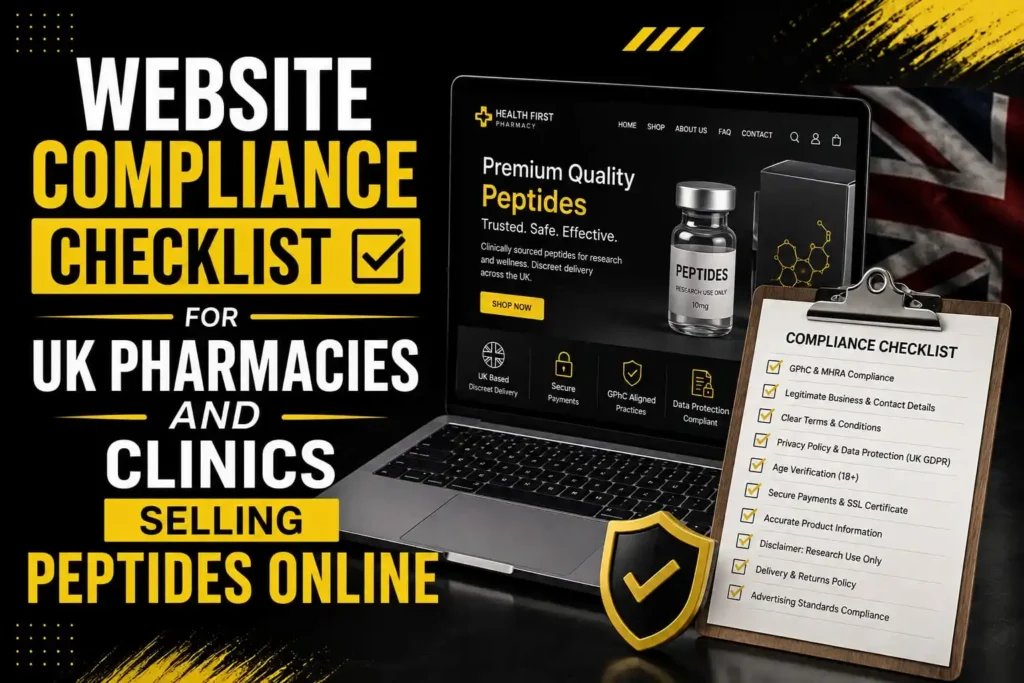
Here is the full checklist in one place, so you can work through it directly.
- GPhC registration number visible and linked
- Named superintendent pharmacist or clinical lead
- Age verification on restricted products
- Clear terms and conditions covering health products
- GDPR compliant privacy policy covering special category data
- No unproven medical claims on any product page
- Clear prescription pathway with clinical review
- Visible, real contact information
- Working cookie consent banner with genuine reject option
- Accessible design meeting basic standards
- Correct classification for every peptide product
- Visible research use disclaimers where relevant
- No unlicensed performance or bodybuilding claims
- Batch testing or certificates of analysis where possible
- Separated marketing and clinical language
- Quarterly review of MHRA advertising rules and content
Get Your Site Checked Properly
Reading a checklist is one thing. Having someone go through your actual site is another. If you want a proper review of your pharmacy or clinic website against current pharmacy website compliance UK standards, we can walk through it together.
You can book a free 30 minute audit call here and get a clear list of fixes, ranked by priority.
For more on how we approach compliant, search friendly marketing for health and fitness brands, visit our home page.